
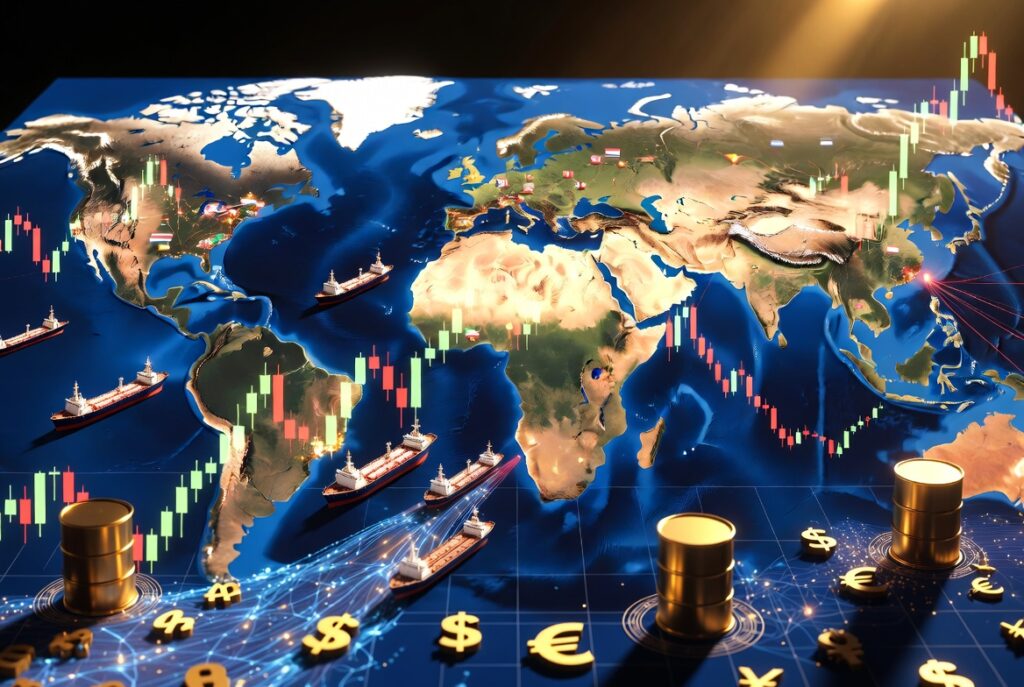
Navigating Turbulence: Geopolitical Forces Reshaping Global Markets in Mid-2026
As of late July 2026, global markets are operating in an environment defined by persistent geopolitical friction rather than isolated shocks. The interplay of armed conflict in the Middle East, ongoing hostilities in Eastern Europe, evolving great-power economic competition, and domestic political calendars is influencing energy prices, trade flows, supply chains, equity valuations, and investor risk appetite. Markets often absorb geopolitical headlines over time, yet the current combination of physical disruptions—especially to energy chokepoints—and structural shifts toward geoeconomic confrontation is creating both near-term volatility and longer-term reallocations of capital.
This analysis examines the primary drivers, their transmission channels into markets, and implications for investors and businesses.
1. The Middle East Conflict and Energy Market Volatility
The dominant near-term geopolitical risk remains the U.S.-Iran conflict that escalated in late February 2026. Military activity has included U.S. strikes, Iranian responses across the Gulf, naval measures affecting ports, and intermittent threats to or restrictions on the Strait of Hormuz—a corridor through which a substantial share of global oil and LNG traditionally flows.
An interim Memorandum of Understanding in June temporarily improved tanker traffic and lifted some restrictions, allowing a partial recovery in Gulf exports and a sharp decline in crude prices. North Sea Dated crude fell toward the high $60s per barrel by early July, briefly erasing wartime gains. Renewed hostilities in early-to-mid July reversed part of that relief. As of late July, benchmark prices have stabilized in a higher but still volatile range, with WTI and Brent futures generally trading in the low-to-mid $80s to around $90 per barrel depending on the contract and day-to-day news flow.
Transmission to markets is multifaceted:
- Crude supply and inventories: Gulf production remains well below pre-conflict levels. Oil-on-water volumes and floating storage have swung sharply with transit conditions. Product markets (diesel, gasoline) have at times been tighter than crude markets due to constrained refining in the region and ongoing Ukrainian strikes on Russian infrastructure.
- Inflation and monetary policy expectations: Energy price spikes feed into headline inflation and transportation costs, complicating central bank paths—particularly if disruptions prove prolonged.
- Secondary effects: Shipping insurance premiums, longer alternative routes, fertilizer and petrochemical feedstock costs, and regional equity markets (energy exporters versus energy importers) all respond.
A sustained reopening could push the market toward surplus in 2027, while renewed closure risks would tighten balances further. Markets have repeatedly rallied on de-escalation signals and sold off on escalation, illustrating that perceived risk often moves prices more than realized physical shortfalls in the short run.
2. Russia-Ukraine War: Persistent but Adapted Impact
The war in Ukraine continues into its fifth year, with Europe remaining the primary external supporter of Kyiv and sanctions pressure on Russia ongoing. Energy-related effects have diminished relative to 2022 as Europe diversified away from Russian pipeline gas and oil, yet residual impacts persist through refined product markets, fertilizer trade, grain corridors, and defense spending.
European governments are elevating defense budgets, creating multi-year demand for aerospace, electronics, software, logistics, and dual-use technologies. This represents a structural shift rather than a pure cyclical one, with estimates of hundreds of billions in cumulative opportunity for non-traditional defense suppliers through the late 2020s.For markets, the conflict contributes to elevated risk premia in European equities at times, supports defense and related industrials, and keeps energy security high on policy agendas.
3. U.S.-China Relations and Geoeconomic Fragmentation
Trade and technology competition between the United States and China remains a core structural force. After significant tariff actions and a sharp contraction in bilateral trade volumes in 2025, 2026 has seen attempts at managed stabilization, including a Trump-Xi meeting in Beijing in May and discussions of a “board of trade” framework for non-sensitive goods, agricultural purchases, and critical minerals.
Key ongoing features include:
- Residual and new tariff authorities.
- Chinese export controls on critical minerals and rare earths, and reciprocal industrial policy responses.
- Supply-chain reconfiguration: companies continue “China+1” or friend-shoring strategies in semiconductors, clean tech, EVs, and pharmaceuticals.
- Rising EU-China tensions, with Europe debating tougher trade defenses, origin requirements, and industrial competitiveness measures amid Chinese overcapacity concerns.
These dynamics raise costs and complexity for global manufacturers while creating opportunities in alternative production hubs (Southeast Asia, India, Mexico, parts of Europe and North America). Critical minerals alliances and domestic industrial policy in the U.S., EU, and elsewhere are accelerating investment in mining, processing, and midstream capacity outside China.4. Domestic Political Calendars and Secondary Risks
The U.S. midterm elections in November 2026 add a layer of policy uncertainty. Polling in late July shows competitive dynamics influenced by economic pressures linked in part to the Iran conflict and cost-of-living concerns. Outcomes could affect the trajectory of tariffs, fiscal policy, energy regulation, and defense spending priorities. A shift in congressional control would likely alter the pace and intensity of industrial policy and trade enforcement.
Elsewhere, elections and leadership transitions in key emerging markets, ongoing fiscal pressures in Europe, and demographic and political challenges in parts of Asia continue to shape capital flows and currency volatility. Secondary risks include potential cyber disruptions to critical infrastructure, maritime incidents beyond the Gulf, and weather-related shocks interacting with already strained supply chains.5. Market Transmission Channels and Asset-Class Implications
Geopolitical developments transmit into markets through several overlapping channels:
- Energy and commodities: Direct price volatility, inventory swings, and shifts in term structure.
- Equities: Sector rotation toward defense, energy, cybersecurity, and domestic industrials; relative underperformance of highly globalized consumer and technology names exposed to tariff or supply-chain risk.
- Currencies and fixed income: Safe-haven flows into the U.S. dollar and Treasuries during acute risk-off episodes; widening credit spreads for energy importers or highly leveraged corporates.
- Inflation expectations and policy rates: Energy-driven upside risks to inflation complicate the path for major central banks, particularly if conflicts persist into late 2026.
- Supply chains and corporate earnings: Higher logistics costs, inventory buffers, and dual-sourcing strategies reduce margins in the near term while creating longer-term capital expenditure opportunities.
Investors have increasingly treated geopolitical risk as a persistent rather than temporary factor, leading to higher risk premia in certain regions and a premium for companies with resilient, diversified operations.6. Strategic Implications for Investors and Businesses
Near-term positioning favors selective exposure to energy producers with flexible export capacity, defense and dual-use technology firms, and companies benefiting from reshoring or friend-shoring trends. Diversification across regions and supply chains remains essential. Longer-term, the fragmentation of global production networks is likely to sustain elevated investment in infrastructure, critical minerals, and energy security.
Businesses should stress-test operations against prolonged Strait of Hormuz disruptions, further tariff escalation, and elevated defense-related demand. Scenario planning that incorporates both de-escalation and renewed conflict remains more valuable than single-point forecasts.
Conclusion
The geopolitical landscape of mid-2026 is characterized by overlapping, persistent pressures rather than a single decisive crisis. Energy markets remain the most immediate transmission mechanism, while structural competition between major powers and elevated defense spending are reshaping capital allocation over multi-year horizons. Markets will continue to price these forces through volatility spikes and sector rotations. For investors and corporate strategists, the key is to distinguish between transitory headline risk and enduring shifts in the global economic architecture—and to position accordingly.
This analysis reflects conditions as of late July 2026 and is for informational purposes only. Markets move quickly — investors should conduct their own due diligence or consult professional advisors for tailored guidance.