
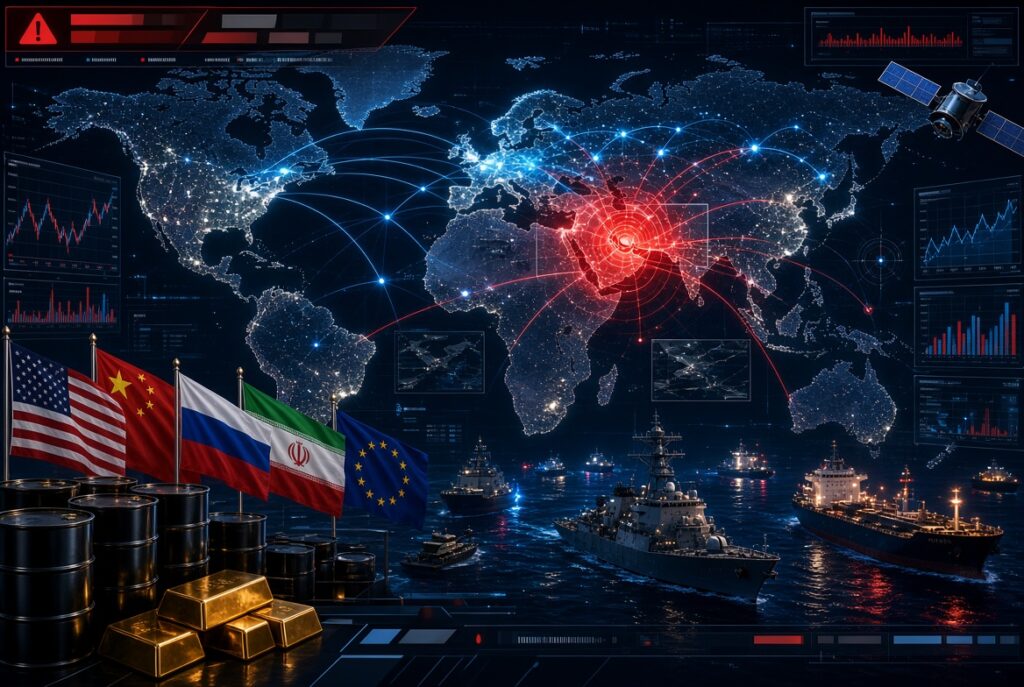
Geopolitical Market Analysis: Persistent Gulf Tensions and Softening U.S. Data Shape Markets on August 17, 2026
As of Monday, August 17, 2026, global financial markets are navigating a familiar but intensifying mix of elevated geopolitical risk and mixed economic signals. The unresolved U.S.-Iran conflict continues to dominate commodity pricing, while weaker-than-expected U.S. consumer data has tempered near-term interest-rate expectations and provided some support for risk assets. Asian equities opened the week largely sideways, oil remains elevated after last week’s gains, and investors remain focused on whether any diplomatic breakthrough can ease the energy risk premium.
The Dominant Driver: Stalled U.S.-Iran Talks and the Strait of Hormuz
The Gulf conflict, which began in late February 2026, remains the central market overhang. The interim ceasefire framework and associated memorandum of understanding have effectively reached their formal endpoint with no durable resolution. Shipping traffic through the Strait of Hormuz—normally carrying about one-fifth of global oil supplies—has slowed sharply, approaching a near standstill over the weekend following additional attacks on tankers. Iranian officials have reiterated hardline conditions for reopening the waterway, while U.S. officials have signaled readiness to maintain a naval blockade indefinitely and potentially impose further economic measures.
Oil prices reflect this deadlock. Brent crude is trading around the high $80s to low $90s per barrel after rising roughly 6% last week, while West Texas Intermediate hovers near the low-to-mid $80s. Market participants generally expect oil to remain in a broad $70–$100 range for now, with Iran’s leverage preventing sustained declines and U.S. efforts likely to moderate extreme spikes. The persistent reduction in Middle East flows (still estimated 10–15% below normal in some assessments) continues to underpin a geopolitical risk premium even as strategic reserves and alternative supplies have prevented a more severe shortage.
Secondary regional developments add complexity. Israeli strikes in southern Lebanon over the weekend killed at least 11 people, including a senior Hezbollah commander—the deadliest such incidents since a U.S.-mediated framework earlier in the year. These actions risk further complicating already stalled broader negotiations.
Secondary Pressures and Macro Backdrop
U.S. economic data released late last week introduced a countervailing force. July retail sales fell 0.6% month-over-month—the largest drop in more than a year—while consumer sentiment weakened more than expected. Households appear to be pulling back amid higher energy costs linked to the conflict. This softer data has reduced market-implied probabilities of a Federal Reserve rate hike in September, contributing to a weaker U.S. dollar and providing some relief to equities and other risk assets.
The AI and technology complex continues to offer structural support. Strong corporate earnings, particularly from infrastructure and semiconductor-related names, have helped major indices log consecutive weekly gains even as they pulled back modestly from recent record levels on Friday. The S&P 500 closed the prior session near 7,785–7,790 territory after touching higher marks earlier in the week.
Other geopolitical threads remain present but secondary in immediate market impact: ongoing Ukraine-related energy and agricultural disruptions, evolving U.S. trade and tariff policies, and longer-term tensions in the Indo-Pacific. Defense spending trends and critical-minerals security continue to shape longer-horizon capital allocation.
Transmission to Markets
Geopolitical risk is feeding through several clear channels:
- Energy prices and inflation expectations remain elevated, supporting sticky components of consumer prices and complicating central-bank decision-making.
- Equity risk premiums stay higher than pre-2026 norms, though concentrated leadership in technology has limited broader drawdowns.
- Shipping and insurance costs for energy and commodity routes remain elevated.
- Safe-haven flows periodically support gold and, at times, certain currencies, though gold has faced intermittent profit-taking.
- Fiscal and industrial-policy responses (defense, energy security, reshoring) create winners in specific sectors.
Asset-Class Snapshot
Energy and commodities: Oil retains a clear geopolitical floor. Incomplete resolution of Hormuz access keeps upside risk alive, while demand concerns and any diplomatic progress could cap gains. Refined products and natural gas remain sensitive to the same dynamics. Agricultural markets face residual Black Sea risks.
Equities: U.S. indices have shown notable resilience, driven by AI-related earnings momentum and reduced rate-hike odds. Energy-sensitive markets and sectors (parts of Europe, India, Japan, and import-dependent emerging economies) face more headwinds from elevated crude. Defense, cybersecurity, and select energy-security themes continue to attract structural interest. Asian markets are mixed to flat at the start of the week, with South Korea closed for a holiday.
Currencies and fixed income: The dollar has softened on the back of weaker U.S. data and lower rate expectations. Bond markets remain sensitive to the interplay between energy-driven inflation risks and growth concerns; term premia stay elevated in a high-geopolitical-risk environment.
Gold: The metal continues to benefit from geopolitical hedging demand but has experienced pullbacks on profit-taking and shifting rate expectations. It remains a key portfolio diversifier in the current regime.
Scenarios Looking Ahead
Base case: Prolonged elevated uncertainty with intermittent diplomatic noise but no clean Hormuz resolution in the near term. Oil trades range-bound with a risk premium. Equities grind higher on earnings and AI momentum while experiencing headline-driven volatility. Inflation stays above pre-conflict targets longer than previously hoped, limiting aggressive monetary easing.
Upside (meaningful de-escalation): Credible progress toward reopening the strait and a broader framework. Energy prices ease, growth outlook improves, risk assets broaden their rally, and safe-haven premiums moderate.
Downside (renewed escalation): Further shipping attacks, wider infrastructure hits, or expansion of regional fighting. Oil spikes, equity risk-off intensifies outside the strongest growth themes, and central banks confront a sharper growth-inflation dilemma.
Investor Considerations and Watchpoints
Markets have adapted to a structural “geo paradigm” in which geopolitical shocks are ongoing rather than purely episodic. Corporate earnings strength and policy buffers have supported resilience so far, yet the distribution of outcomes remains unusually wide.
Key items to monitor in the coming days and weeks:
- Any concrete developments on Hormuz shipping protocols, mediated talks, or shifts in U.S./Iran rhetoric and sanctions.
- Daily tanker transit data and insurance rate movements.
- Upcoming U.S. economic releases (housing, industrial production, FOMC minutes) for confirmation of consumer and growth trends.
- Corporate commentary on energy costs, supply-chain resilience, and capital-expenditure plans.
- Regional spillover risks, particularly involving Lebanon/Hezbollah or further Black Sea disruptions.
Positioning framing (not advice): Diversification remains essential. Structural overweight considerations include quality growth (especially AI infrastructure), defense and energy-security themes, and selective commodity exposure. Tactical hedges in energy and gold can help manage binary geopolitical outcomes. Scenario analysis and disciplined position sizing are particularly important while the Hormuz impasse persists.
In summary, August 17 markets reflect a tug-of-war between persistent Gulf-related energy risk and softening U.S. demand signals that have eased immediate rate-hike fears. Equity resilience has so far been underwritten by technology earnings, but the elevated oil price and stalled diplomacy ensure geopolitics will remain a primary driver of volatility and relative performance. Investors are best served treating these developments as a core, continuous input to portfolio construction rather than temporary noise.
This analysis is for informational and educational purposes. Market conditions change rapidly—always conduct your own due diligence or consult a financial advisor