
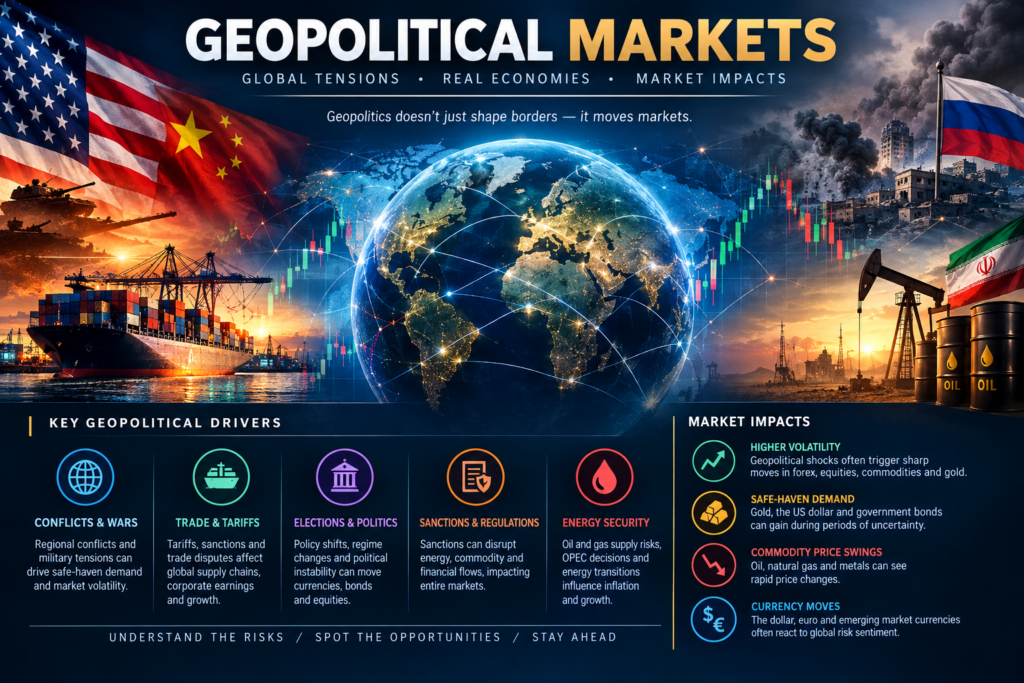
In-Depth Geopolitical and Market Analysis: October 12, 2026
Global markets and geopolitics remain tightly intertwined on Monday, October 12, 2026, as energy shocks from the Middle East, contested diplomacy in the Russia-Ukraine war, and approaching U.S. midterms shape investor sentiment and risk premiums. Oil prices eased on hopes of additional Russian supplies, equities showed resilience after a strong prior week, and gold found support from softer energy costs—yet underlying fragilities from prolonged conflicts and elevated debt levels persist.
Escalating Conflict in the Middle East
The most immediate flashpoint is the intensification of Houthi attacks on Saudi Arabia. On Saturday, a missile strike on King Khalid International Airport in Riyadh killed at least 12–13 people (including Saudi, Bangladeshi, U.S., and other nationals) and injured more than 300. A follow-up projectile hit a passenger terminal on Sunday, causing further injuries and a fire. Operations at the airport were suspended, flights diverted, and schools in Riyadh shifted to remote learning.
Yemen’s Iran-aligned Houthis claimed responsibility, framing the strikes as retaliation for Saudi actions and warning airlines away from Saudi airports. The attacks mark a sharp escalation after a truce breakdown earlier in the year and form part of a broader regional crisis involving the ongoing Iran-related hostilities, pressures on the Strait of Hormuz, and threats to the Bab al-Mandab strait. Saudi Arabia has vowed a firm response; the U.S. under President Donald Trump is weighing deeper involvement; and partners including the UK (defensive support and refueling), Pakistan, and Turkey are accelerating mutual defense coordination. Interceptor missile stocks are reportedly strained.
These developments keep a risk premium in energy markets and raise the prospect of wider regional entanglement, even as tanker incidents and supply-route concerns continue.
Russia-Ukraine: Contested “Energy Ceasefire” and High Casualties
U.S. President Donald Trump announced on Sunday that Russia and Ukraine had agreed to an “energy ceasefire” effective immediately, urging both sides not to break it. Ukrainian President Volodymyr Zelensky said the claim was news to him and that Kyiv was awaiting details from Washington, while expressing readiness to halt strikes on Russian energy infrastructure if Russia reciprocated. Moscow has not confirmed the deal. Russian strikes on Ukrainian energy facilities reportedly continued after the announcement.
The move follows Trump’s recent temporary sanctions relief allowing Russian diesel onto U.S. and global markets (initial shipment around 300,000 tones, with more planned) aimed at lowering elevated U.S. fuel prices ahead of the November midterms. Analysts note the volumes are modest relative to daily consumption and transport timelines are multi-week, limiting near-term price impact. The deal has drawn bipartisan U.S. criticism and pushback from European officials and Kyiv, who argue it could bolster Russian revenues.
Separately, a senior NATO official estimated Russian casualties in Ukraine exceeded 50,000 in September (including up to 28,000 killed), versus roughly 5,000 Ukrainian casualties. Ukraine has recaptured territory and continued deep strikes, while Russian defense spending remains elevated.
U.S. Political Backdrop and Midterms
With midterms weeks away, the environment is challenging for the incumbent party. Democrats hold a substantial lead on the generic congressional ballot in recent polling (often in the high single to double digits), with competitive races in states and districts that were previously safer for Republicans. Energy prices, the Middle East conflicts, and economic pressures are prominent voter concerns. Trump faces additional scrutiny over the Russia diesel arrangement, a federal judge’s order halting taxpayer-funded ads featuring him, and questions about popularity.
Broader Global Context
IMF and World Bank meetings in Bangkok are dominated by the combination of Middle East war-driven energy shocks, high public debt (projected to exceed 100% of global GDP before 2030), and constrained growth (around 3% forecast). Developing economies face heavy external debt servicing. Other notable developments include large-scale protests and detentions in India over voter-roll revisions, a state of emergency in Pakistan’s Khyber Pakhtunkhwa province amid political tensions involving Imran Khan’s party, and UK Prime Minister Andy Burnham stating that Russia interfered in the 2016 Brexit referendum.
Market Snapshot and Interconnections
Equities: Wall Street closed a strong week higher, with the S&P 500 near 7,811, the Dow around 51,655, and the Nasdaq Composite near 27,366. Futures pointed higher into Monday. Asian markets were mixed/choppy ahead of earnings season; Indian indices opened positively (supported by rupee strength after RBI measures) before seeing some profit-taking. Major U.S. bank earnings begin Tuesday.
Energy: Brent crude traded in the low-to-mid $103 range (down roughly 1–1.5% at points), with WTI around $90–91, after earlier support from Houthi and tanker risks. The Trump energy-ceasefire claim and Russian diesel prospects provided relief, though Middle East supply threats limited the downside. Prices remain elevated relative to pre-Iran-war levels.
Precious metals and other: Gold hovered near or above $4,200 per ounce, supported by softer oil prices (easing some inflation and rate-hike pressure) and a relatively muted dollar. Silver also firmed.
The core market dynamic is the tug-of-war between geopolitical risk premia (Middle East escalation supporting energy prices and safe-haven demand) and policy/diplomatic signals (ceasefire talk and diesel supply hopes capping oil). Persistent high energy costs feed into inflation concerns and keep rate-hike probabilities elevated for later in the year, while debt levels and inventory drawdowns add to fragility. Equity resilience reflects ongoing AI/tech momentum and earnings expectations, but valuations leave limited room for negative surprises.
Outlook
Near-term focus centers on confirmation (or lack thereof) of any Russia-Ukraine energy pause, Saudi and allied responses to the Houthis, U.S. inflation data this week, and bank earnings. A sustained de-escalation in energy infrastructure attacks or meaningful additional Russian supplies could ease oil and inflation pressure, supporting risk assets. Conversely, further Houthi or regional strikes, or continued fighting without restraint, would reinforce the energy risk premium and complicate the midterm political environment. Global growth remains constrained by the cumulative effects of conflict, high debt service, and elevated input costs.
This remains a high-uncertainty environment in which geopolitical developments continue to drive commodity volatility and policy responses more than pure economic fundamentals. Markets will closely parse official statements from Washington, Kyiv, Moscow, and Riyadh in the days ahead.
This analysis reflects conditions as of early October 12th, 2026. The analysis is for informational and educational purposes. Market conditions change rapidly—always conduct your own due diligence or consult a financial advisor.