
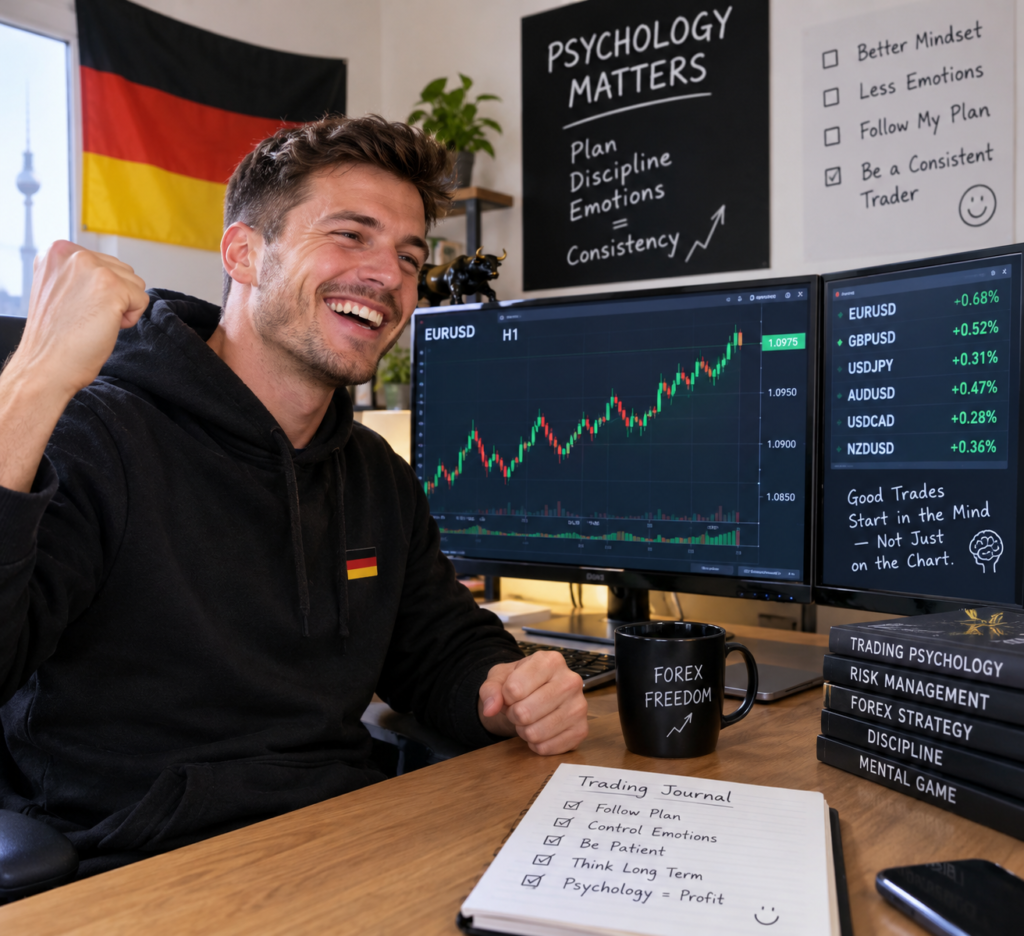
Forex Psychology for German Traders ( A Forex Psychology Guide for 2026)
Forex trading psychology refers to the mental and emotional factors that influence a trader’s decision-making in the foreign exchange market. It covers how emotions, cognitive biases, mindset, and discipline shape entries, exits, position sizing, and overall performance—often more than technical or fundamental analysis alone.
Studies and experienced traders frequently note that success in Forex is roughly 20% strategy and 80% psychology and risk management. The market is inherently uncertain, leveraged, and fast-moving, which amplifies emotional reactions. Without strong psychological control, even a solid strategy fails.
Why Psychology Matters So Much in Forex
- Emotions drive impulsive actions: Fear can cause early exits from winning trades or avoidance of valid setups. Greed leads to oversized positions, holding losers too long, or overtrading. Revenge trading (trying to “get back” losses), euphoria after wins, and pride (refusing to admit mistakes) compound problems. tradingpedia.com
- Losses are inevitable: The best systems still produce losing trades. Psychology determines whether a trader accepts them as part of the process or lets them trigger emotional spirals that destroy the account.
- Leverage and volatility amplify effects: Small emotional mistakes become large financial ones quickly.
- Consistency requires discipline: A trading plan is useless if emotions override it. Professional results come from following rules mechanically rather than reacting to every price tick.
- Long-term survival: Most retail traders lose money not primarily because of bad strategies, but because of psychological failures such as abandoning risk management during drawdowns.
Key cognitive biases that frequently sabotage Forex traders include:
- Loss aversion — Losses feel roughly twice as painful as equivalent gains feel good, leading traders to hold losers and cut winners early.
- Overconfidence — After a winning streak, traders increase size or skip rules.
- Confirmation bias — Seeking only information that supports an existing view while ignoring contrary signals.
- Recency bias / gambler’s fallacy — Overweighting recent results or believing a streak “must” reverse.
- Anchoring — Fixating on a past price level.
- FOMO (fear of missing out) and herd behavior.
Specific Considerations for German Traders
German business and cultural norms often emphasize discipline, planning, precision, structure, risk awareness, and methodical decision-making. These traits align well with the requirements of successful trading:
- A preference for clear rules, checklists, and systematic processes supports consistent execution of a trading plan.
- Caution and thorough analysis can help with proper risk management and avoiding impulsive “get-rich-quick” behavior.
- Formal, task-oriented approaches favor treating trading as a business rather than entertainment or speculation.
However, these same strengths can create challenges:
- High standards and perfectionism may lead to excessive analysis (analysis paralysis) or reluctance to take valid setups when conditions are not “perfect.”
- Strong loss aversion or a cultural emphasis on avoiding failure can make accepting small, planned losses psychologically harder.
- In a regulated European environment (with ESMA leverage limits, strict broker oversight, and a more conservative retail trading culture compared with some U.S. markets), German traders may face additional pressure to perform “correctly,” which can heighten self-criticism after mistakes.
German-language resources and coaches (e.g., discussions by trading psychologists such as Julia Thiele or coaches featured by Deutsche Börse) frequently stress the same universal principles: maintain a trading journal, define rules in advance, separate the “trader” from the “risk controller,” and treat emotions as data rather than directives. The structured German approach can be a significant advantage when deliberately applied to psychology training.
Practical Ways to Strengthen Forex Psychology
- Develop and strictly follow a written trading plan — Define entry/exit criteria, risk per trade (typically 0.5–2% of capital), maximum daily/weekly loss limits, and conditions under which you stop trading.
- Keep a detailed trading journal — Record not only trades but also emotional state, reasons for decisions, and deviations from the plan. Review it regularly to spot patterns.
- Practice risk management religiously — Position sizing and stop-losses are the primary defense against emotional damage.
- Build routines that reduce emotional intensity — Pre-market checklists, scheduled breaks, physical exercise, adequate sleep, and limiting screen time after losses.
- Reframe losses and wins — Focus on process (did I follow the rules?) rather than outcome. Accept that a series of losses does not invalidate a positive-expectancy system.
- Use demo or small-size trading for psychological practice before scaling.
- Seek external feedback — Coaching, peer review, or structured education can help identify blind spots.
- Cultivate patience and realism — Forex is a marathon. Unrealistic expectations about rapid wealth are one of the fastest routes to emotional breakdown.
In short, technical skill and market knowledge get you into the game; psychology keeps you in it long enough to become consistently profitable. For German traders, leveraging cultural strengths in discipline and structure while consciously working on emotional flexibility and acceptance of uncertainty provides a strong foundation.
Mastering the inner game turns the market from an emotional rollercoaster into a probabilistic business that can be managed with clarity and resilience.
#TradingPsychologie #Devisenhandel #Börsenpsychologie #DeutscherTrader #TradingDeutschland #MentaleStärke #ForexLernen #TradingPsychologie #ForexTrading #TradingMindset #Disziplin #Risikomanagement #ForexTrader #DayTrading #TradingPsychologie #EmotionenImTrading #TradingJournal #FearAndGreed #TradingDisziplin #MentaleStärke
Devisenhandel lernen Forex Trading lernen Trading Strategie + Psychologie Risikomanagement Forex Trading Plan erstellen Disziplin im Trading Trading Coach Deutschland Börse Psychologie FinanzpsychologieTrader Psychologie
Risk Warning: CFDs are complex instruments and come with a high risk of losing money rapidly due to leverage. 100% of retail investor accounts lose money when trading CFDs with this provider.
You should consider whether you understand how CFDs work and whether you can afford to take the high risk of losing your money.