
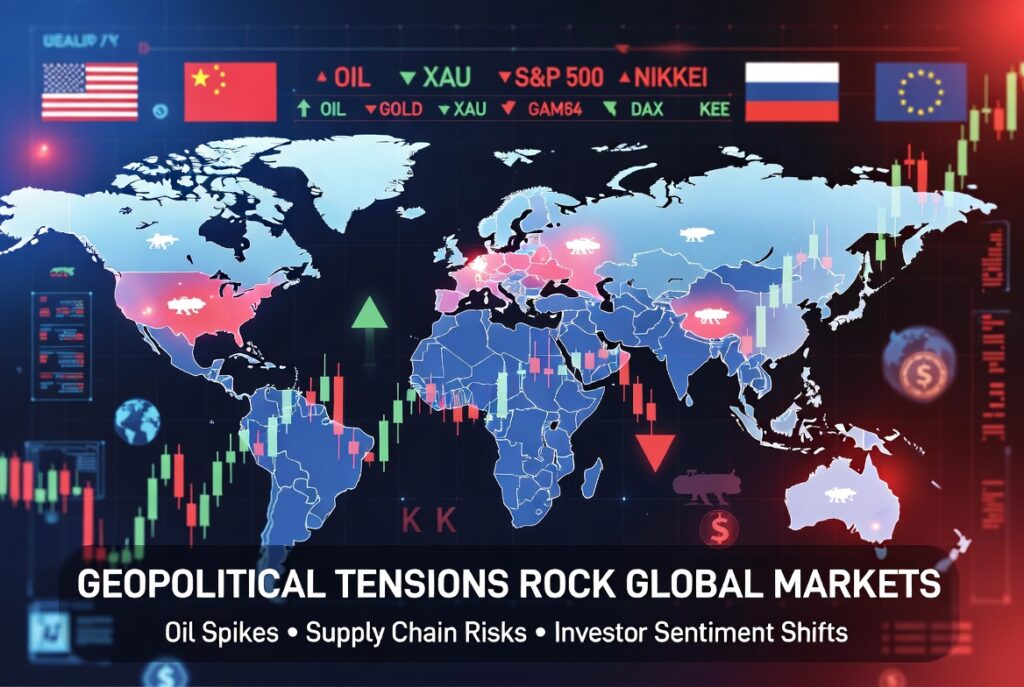
Global Markets Navigate Rising Geopolitical Tensions and Energy Volatility
Global financial markets are entering the final week of May under heightened geopolitical pressure, as investors balance resilient equity momentum against renewed energy market instability, central bank uncertainty, and growing concerns over global trade fragmentation.
While equity markets remain relatively resilient, underlying volatility is increasing across commodities, currencies, and sovereign debt markets. The key driver continues to be the evolving geopolitical landscape centered around the Middle East, Russia-Ukraine developments, and renewed tariff tensions between major economies.
Oil Markets Remain the Primary Global Risk Catalyst
Energy markets continue to dominate investor sentiment.
The ongoing instability surrounding the Strait of Hormuz — a critical shipping corridor responsible for nearly 20% of global oil flows — remains the largest geopolitical risk facing markets today. Any prolonged disruption could significantly impact global inflation and economic growth.
Brent crude remains elevated near multi-month highs as traders price in the possibility of supply interruptions and tighter global inventories. European officials have already warned that prolonged instability could tighten jet fuel and refined petroleum markets in the coming weeks.
Markets are currently pricing a “managed instability” scenario rather than a full-scale supply shock. However, volatility remains extreme, with oil prices reacting sharply to every diplomatic or military headline involving Iran, the United States, and Gulf shipping routes.
For investors, elevated oil prices present a dual challenge:
- Higher inflation expectations
- Reduced probability of aggressive central bank rate cuts
Central Banks Face a Difficult Balancing Act
Global central banks are increasingly trapped between slowing economic growth and persistent inflationary pressure.
The Federal Reserve, European Central Bank, and Bank of England had initially been expected to begin more accommodative monetary policies during the second half of 2026. However, rising energy prices and geopolitical uncertainty are complicating those expectations.
Markets now fear that inflation could remain “stickier” for longer, especially if energy disruptions continue into summer. Several investment banks have already revised inflation forecasts upward due to oil-driven price pressures.
This environment is creating uncertainty across bond markets, where yields have become increasingly volatile as investors reassess interest-rate expectations.
Equity Markets Show Resilience — But Risks Are Building
Despite geopolitical uncertainty, global equity markets have remained surprisingly resilient.
Technology and AI-related sectors continue attracting capital, while investors appear willing to overlook geopolitical headlines unless they materially disrupt corporate earnings or global trade flows.
However, several warning signals are emerging:
- Energy-sensitive industries are under pressure
- Transportation and airline sectors face rising fuel costs
- Emerging markets remain vulnerable to commodity shocks
- European manufacturing continues to weaken amid energy concerns
Analysts increasingly warn that markets may be underestimating the long-term economic impact of prolonged geopolitical fragmentation.
Currency Markets Reflect Growing Global Uncertainty
Foreign exchange markets are also showing signs of defensive positioning.
The U.S. dollar has strengthened as investors seek safe-haven assets during periods of geopolitical instability. Meanwhile, energy-importing economies across Europe and Asia are experiencing increased pressure on their currencies due to higher import costs and inflation exposure.
Gold prices have also remained supported as institutional investors hedge against geopolitical escalation and potential financial-market volatility.
Russia-Ukraine Conflict Continues to Influence European Markets
Although market attention has shifted heavily toward the Middle East, the Russia-Ukraine conflict continues to affect energy flows, sanctions policy, and European industrial confidence.
Ongoing disputes over pipeline access and energy transit routes are keeping pressure on European energy security and regional supply chains.
Investors remain highly sensitive to any developments involving sanctions, natural gas infrastructure, or Eastern European trade routes.
What Investors Should Watch Next
Over the coming weeks, markets will closely monitor:
1. Strait of Hormuz Shipping Activity
Any further disruption could trigger another major oil spike.
2. Central Bank Guidance
Investors need clarity on whether inflation risks will delay interest-rate cuts.
3. U.S.–Iran Diplomatic Developments
Any sign of de-escalation could rapidly reduce energy market volatility.
4. Global Inflation Data
Higher-than-expected inflation could pressure both equities and bonds simultaneously.
5. Trade and Tariff Policies
Renewed protectionist measures could further slow global growth and weaken manufacturing activity.
Final Market Outlook
The current market environment reflects a fragile balance between economic resilience and geopolitical risk.
While investors continue supporting risk assets, underlying macroeconomic vulnerabilities are increasing. Energy remains the central transmission mechanism connecting geopolitical conflict to inflation, monetary policy, and market sentiment.
Unless geopolitical tensions ease meaningfully, volatility across oil, currencies, and global equities is likely to remain elevated throughout the summer.
For traders and investors, risk management and diversification remain essential as markets navigate one of the most geopolitical sensitive periods in recent years.