Geopolitical Market Analysis – May 28, 2026
Global financial markets are trading under heightened geopolitical tension as investors react to renewed instability in the Middle East, persistent inflation concerns, and growing uncertainty surrounding global trade and monetary policy. Risk sentiment remains fragile, with volatility increasing across commodities, currencies, equities, and bond markets.
Middle East Escalation Dominates Market Sentiment
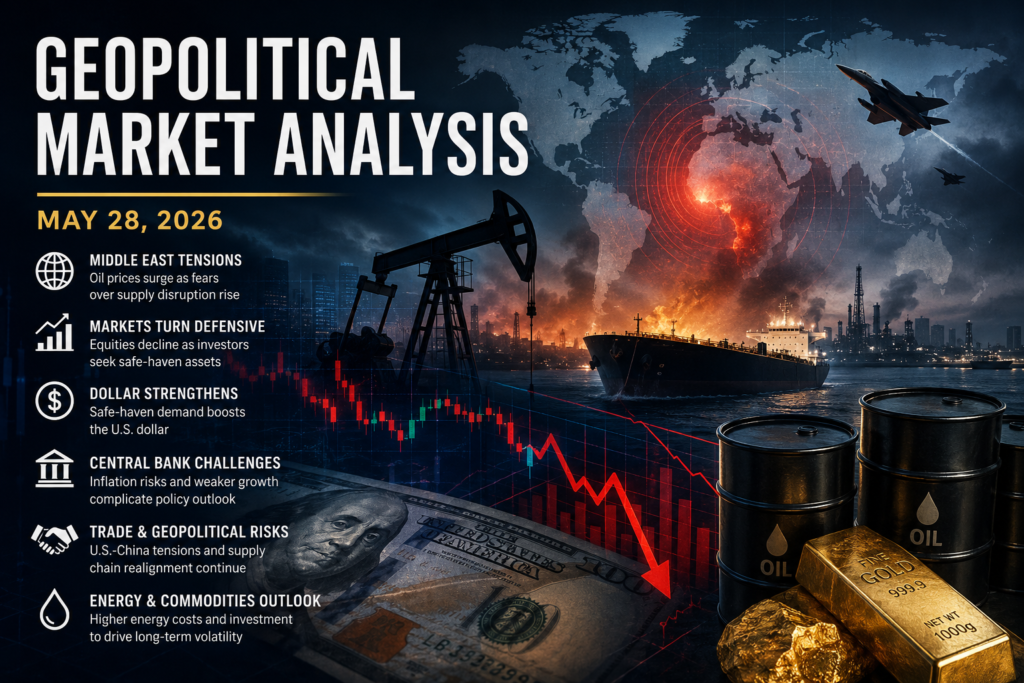
The primary driver of today’s market moves is the renewed escalation between the United States and Iran, particularly around the Strait of Hormuz — a critical shipping route responsible for roughly 20% of global oil flows. Fresh military activity and disruptions to regional shipping have reignited fears of a prolonged energy supply shock.
Oil markets reacted sharply:
- Brent crude surged toward the $97/barrel region
- WTI crude climbed above $90/barrel
- Shipping insurance costs and freight premiums rose significantly
- LNG markets in Europe and Asia remain under pressure
Analysts warn that sustained disruption in Hormuz could push oil back above $100 per barrel, reviving stagflation concerns globally.
For markets, this creates a dangerous combination:
- Higher inflation
- Slower global growth
- Reduced probability of aggressive central bank rate cuts
Energy-sensitive sectors, airlines, transport, and manufacturing equities are particularly vulnerable if crude prices remain elevated.
Equity Markets Turn Defensive
Asian markets led today’s declines as investors reduced exposure to risk assets:
- Japan’s Nikkei fell sharply
- South Korea’s KOSPI posted significant losses
- European futures opened lower
- U.S. equity futures also weakened amid rising geopolitical uncertainty
Investors are increasingly rotating toward defensive positioning:
- Energy stocks outperforming
- Defense and cybersecurity sectors attracting inflows
- Utilities and commodity-linked assets gaining support
Meanwhile, growth and technology sectors are facing renewed pressure due to rising yields and inflation fears.
The U.S. Dollar Strengthens as Safe-Haven Demand Returns
Currency markets are showing classic “risk-off” behavior.
The U.S. dollar strengthened against most major currencies as investors sought liquidity and safety. The Japanese yen and Swiss franc also benefited from defensive flows, while emerging market currencies weakened.
EUR/USD remains vulnerable due to:
- Europe’s dependence on imported energy
- Slowing Eurozone growth
- Inflationary spillover from higher oil prices
The dollar’s strength is also being reinforced by expectations that the Federal Reserve may keep rates elevated longer than previously expected.
Central Banks Face a Difficult Environment
Global central banks are now navigating a far more complex macroeconomic backdrop.
Markets are increasingly concerned that:
- Inflation could reaccelerate due to energy prices
- Growth may weaken simultaneously
- Monetary easing cycles could be delayed
The Federal Reserve, ECB, and Bank of England are all under pressure to balance inflation control against deteriorating economic momentum.
This environment resembles a mild stagflationary setup:
- Slower growth
- Sticky inflation
- Elevated commodity prices
- Weak consumer confidence
Bond markets are reflecting this uncertainty, with Treasury yields remaining volatile as traders reassess future rate expectations.
China and Global Trade Risks Remain a Secondary Concern
While the Middle East dominates headlines, structural geopolitical tensions between the United States and China continue to weigh on long-term investor sentiment.
Ongoing disputes around:
- Semiconductor export controls
- AI technology restrictions
- Critical mineral supply chains
- Industrial policy competition
continue to reshape global investment flows and supply chain strategies.
Multinational corporations are increasingly diversifying manufacturing away from concentrated geopolitical risk zones, accelerating the long-term trend toward supply chain regionalization.
Commodities and Energy Outlook
Energy remains the key macro variable for markets.
Global investment in natural gas infrastructure and LNG capacity is expected to rise sharply as countries seek alternatives to Middle Eastern supply dependence.
Key themes developing:
- Higher long-term energy security spending
- Increased LNG demand
- Strategic reserve accumulation
- Accelerated renewable energy investment
- Greater volatility in oil and gas pricing
Gold, traditionally a safe haven, has shown mixed performance as higher yields and a stronger dollar offset some geopolitical demand.
Outlook for Traders and Investors
Markets are entering a period where geopolitical developments may override traditional economic fundamentals in the short term.
Key risks to monitor:
- Further escalation between the U.S. and Iran
- Any prolonged closure or disruption of Hormuz shipping lanes
- Oil price stability above $100/barrel
- Inflation data from the U.S. and Europe
- Central bank policy reactions
- Supply chain disruptions in energy and shipping
Until clarity emerges, volatility is likely to remain elevated across:
- FX markets
- Commodities
- Global equities
- Bond yields
Investors are expected to remain defensive, favoring:
- Energy exposure
- Safe-haven currencies
- Defensive equities
- Inflation hedges