
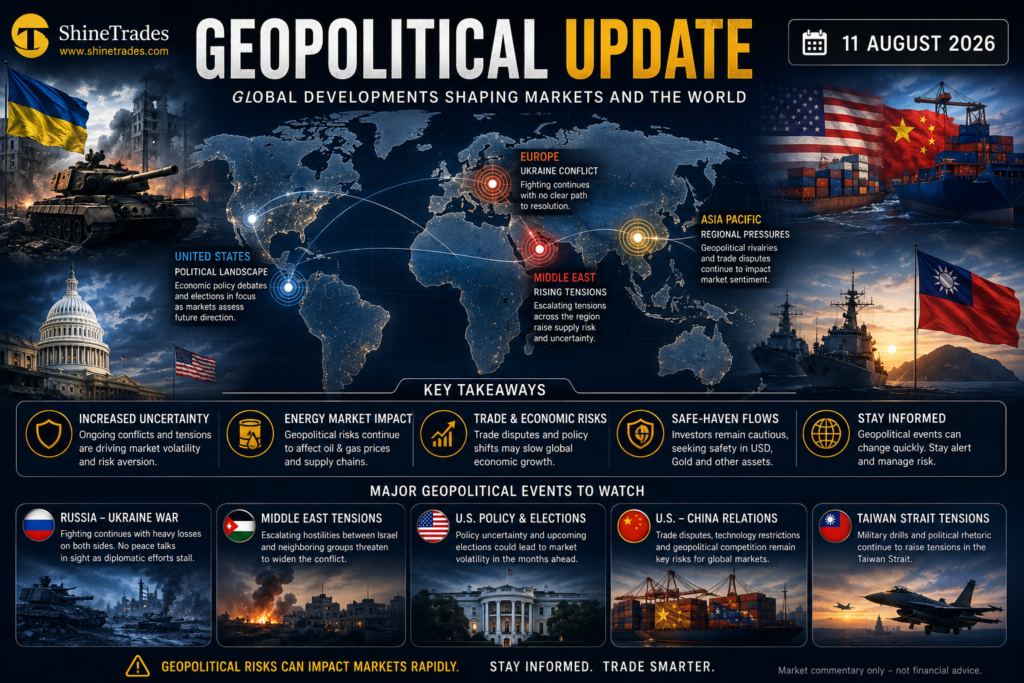
In-Depth Geopolitical and Market Analysis: August 11, 2026
As of Tuesday, August 11, 2026, the global landscape continues to be dominated by the unresolved U.S.-Iran confrontation and the status of the Strait of Hormuz. Diplomatic progress on technical shipping arrangements coexists with firm Iranian conditions for any full reopening, keeping energy markets on edge. Soft U.S. labor data from the previous week has supported equities near recent highs, but rising oil prices and upcoming inflation figures introduce fresh caution. Parallel developments in Ukraine, Gaza, and other regions add layers of complexity without yet derailing the broader market narrative.
Geopolitical Landscape
Strait of Hormuz and the U.S.-Iran Conflict
Iran and Oman remain close to finalizing an agreement on new shipping lanes through the Strait of Hormuz, with Iranian officials describing the talks as being in their final stages. However, Tehran has reiterated that any such technical arrangement will not automatically reopen the waterway. Full restoration of traffic is conditioned on a comprehensive set of U.S. actions, including compensation for wartime damage, lifting the naval blockade of Iranian ports, removal of sanctions, release of frozen assets, withdrawal or reduction of U.S. military presence in the region, and an end to threats or operations against Iran and its regional allies.
U.S. President Donald Trump has maintained a restrained posture, describing the approach as “low-key” and “semi-negotiating,” while emphasizing that economic pressure—driven by high Iranian inflation—can be allowed to build. Limited vessel movements continue under constrained conditions, but recent incidents, including a reported attack on a vessel linked to the United Arab Emirates, underscore persistent security risks. The standoff keeps a significant portion of global oil and gas trade under disruption, sustaining a geopolitical risk premium in energy markets.
Ukraine-Russia War
Cross-border strikes intensified over the weekend and into the start of the week. A Ukrainian drone attack on an oil-refining facility in Russia’s Tatarstan region killed at least 13 people, marking one of the more significant strikes deep inside Russian territory. Russian forces continued attacks on Ukrainian cities, including residential areas in Kharkiv and other regions, resulting in civilian casualties. Both sides report ongoing drone and missile activity, with air-defense constraints remaining a critical factor for Ukraine. The conflict shows no near-term diplomatic resolution, maintaining pressure on European security and energy considerations.
Gaza and Broader Middle East
Israeli Prime Minister Benjamin Netanyahu has publicly rejected a U.S.-backed 15-point Gaza plan that Hamas had indicated it could accept. Netanyahu insists that Israeli forces will not withdraw until Hamas is fully disarmed, prioritizing domestic political considerations ahead of upcoming elections. This creates visible daylight with Washington and prolongs uncertainty over the next phase of the conflict. Related activity by Houthi forces in Yemen, including attacks on Saudi infrastructure, continues to add regional volatility.
Other Developments
A powerful 7.4-magnitude earthquake struck western Colombia, killing more than 100 people and prompting a state of emergency as rescue operations continue. Pakistan, Saudi Arabia, and Turkey formalized a joint defense agreement aimed at collective deterrence. Other notes include ongoing weather impacts in Asia and various domestic political and security developments across multiple countries.Market Analysis
Equities
U.S. stocks drifted slightly lower on Monday after a strong prior week that saw the S&P 500 reach fresh record territory. The S&P 500 closed near 7,753, the Dow Jones Industrial Average around 53,976, and the Nasdaq Composite modestly lower. Gains earlier in the week and the previous Friday were driven by an unexpectedly weak July jobs report (a decline of 23,000 payrolls and downward revisions to prior months), which reduced the likelihood of a near-term Federal Reserve rate hike. Technology and AI-related names provided leadership, while energy stocks benefited from the rebound in oil. Asian markets were mixed to modestly higher into Tuesday, with attention shifting to this week’s U.S. inflation data.
Commodities and Energy
Oil prices extended a multi-day rally on Monday, with Brent crude climbing toward the high $80s per barrel (around $87–$88 in recent trading) and WTI also advancing sharply. The move reflected fading hopes for an imminent, unconditional reopening of the Strait of Hormuz after Iran restated its conditions. Prices remain highly sensitive to diplomatic headlines and any new incidents involving shipping.
Gold held firm near multi-week highs in the $4,300–$4,400 range (with some sessions testing higher levels), supported by residual geopolitical risk, a softer rate-hike outlook, and positioning ahead of inflation data. The metal posted strong weekly gains recently before consolidating.
Central Banks and Macro Backdrop
The weak July U.S. employment report has shifted market expectations, lowering the probability of a September Federal Reserve rate increase. Focus now turns to July consumer and producer price data due later this week, which will provide clearer signals on inflation persistence and the policy path. Energy-price volatility remains a key variable: sustained higher oil would reintroduce inflationary pressure, while a credible Hormuz resolution could reverse that dynamic. Other major central banks continue to monitor the energy shock’s second-round effects.
Interconnections and Outlook
Energy remains the critical transmission channel between geopolitics and financial markets. Iranian insistence on linking any Hormuz arrangement to broad U.S. concessions has supported oil prices and limited the downside risk for gold, even as equities have drawn strength from softer domestic U.S. data and solid corporate earnings. A breakthrough that meaningfully restores shipping volumes without major new Iranian leverage would likely ease oil, support risk assets, and moderate safe-haven demand. Prolonged stalemate or renewed kinetic activity would keep energy elevated and sustain volatility.
Ukraine’s deep strikes and Gaza’s political impasse add secondary risks but have so far played a lesser role in near-term market pricing. The approaching potential inflection points around earlier U.S.-Iran frameworks later this month raise the stakes for any diplomatic movement.
Near-term watchpoints
- Any finalization or further conditions attached to the Iran-Oman shipping framework and U.S. responses.
- Shipping data, incidents, or statements regarding the Strait of Hormuz.
- U.S. July CPI and PPI releases and resulting shifts in Federal Reserve expectations.
- Intensity of Russia-Ukraine strikes, particularly against energy infrastructure.
- Developments in Gaza negotiations and Israeli political dynamics.
- Corporate earnings and any further AI or energy-sector reactions.
Overall, markets are balancing domestic U.S. data optimism against persistent Middle East energy uncertainty. The environment favors selective positioning and close monitoring of oil as the primary near-term sentiment driver. Investors should prepare for continued headline sensitivity as diplomatic and military tracks evolve in parallel through the mid-August period.
This analysis is for informational and educational purposes. Market conditions change rapidly—always conduct your own due diligence or consult a financial advisor.