
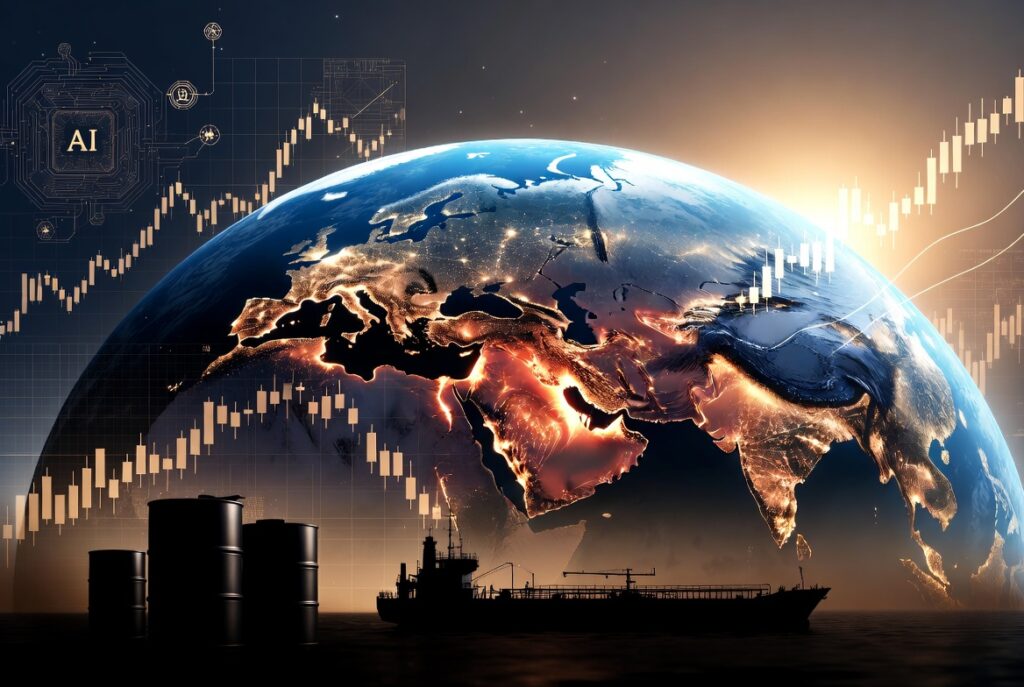
Geopolitical Market Review: Mid-2026 – Fragile Ceasefires, Energy Shocks, and Resilient Markets
As of June 2026, global markets continue to demonstrate remarkable resilience amid persistent geopolitical turbulence. A fragile ceasefire in the Middle East, ongoing disruptions in key energy chokepoints, and shifting great-power dynamics define the landscape. Investors have largely priced in short-term risks, allowing equities to rebound while commodities and certain sectors face sustained pressure.
Middle East Tensions and the Oil Shock
The dominant story remains the escalation involving the US, Israel, and Iran. Military operations intensified earlier in 2026, leading to significant disruptions in the Strait of Hormuz — through which roughly one-fifth of global oil typically flows. Shipping traffic has plummeted, triggering sharp production cuts in the Middle East and large inventory draws.
Oil prices spiked as a result, with Brent crude averaging around $105/bbl in recent months under tight supply assumptions. However, markets have shown signs of anticipating de-escalation: prices have moderated on reports of potential resumed transits and ceasefire extensions. Forecasts suggest a potential drop toward $79/bbl in 2027 if flows normalize, though the truce remains uneasy and vulnerable to renewed strikes.
Market Impact: Energy stocks have benefited selectively, but broader equities initially dipped before recovering strongly after the April ceasefire announcement. US and emerging market indices have hit new highs as investors bet on contained disruption. Inflation concerns have risen, complicating central bank paths, but repeated geopolitical shocks appear to have built some investor “immunity.”
Russia-Ukraine remains a grinding conflict with drone warfare innovations, adding to European energy and security strains but with less immediate market-moving power than Middle East events.
Great Power Dynamics: US, China, and Russia
US-China relations feature persistent trade frictions and tariffs, though some negotiations and pauses have tempered the worst outcomes. China has deepened ties with Russia, benefiting from discounted energy imports amid Western sanctions on Moscow. Bilateral trade has grown robustly, with Russia supplying energy and China providing industrial and technological support.
This axis complicates global supply chains and commodity flows. Meanwhile, US policy emphasizes tariffs, fiscal measures, and selective interventions, contributing to volatility in bonds, the dollar, and risk assets.Market Impact: Protectionism and supply chain shifts support inflation but also favor certain domestic or reshored sectors. AI investment continues as a powerful counterweight, driving US equity outperformance despite macro headwinds.
Broader Market Performance and Sentiment
- Equities: US indices have recovered strongly post-ceasefire, outperforming many international peers. Polarization persists — tech/AI leaders thrive while cyclical or energy-dependent areas lag.
- Commodities: Oil and gold (as a safe haven) have seen upside from tensions. Agricultural and other inputs face secondary pressures from disrupted trade.
- Bonds and Currencies: Yields rose on inflation and policy uncertainty; the dollar has been supported by relative US strength.
- Outlook Nuances: Global GDP growth projections hover around 3.2%, with divergences between the US (more resilient) and Europe/EM (more exposed to energy shocks).
Historical patterns hold: Geopolitical events often cause short-term volatility but fade in long-term impact unless they fundamentally alter supply chains, growth, or inflation trajectories. Markets have repeatedly “looked through” headlines when escalation risks ease.
Key Risks and Opportunities for Investors
Downside Risks:
- Renewed Middle East escalation or prolonged Hormuz closure → sustained high energy prices and stagflationary pressure.
- US-China tariff spirals or broader trade wars.
- Unexpected shocks in Ukraine or other flashpoints.
Opportunities:
- Energy transition and security-driven defense/tech spending.
- AI productivity gains as a secular growth driver.
- Selective EM exposure if de-escalation materializes and commodity exporters stabilize.
Investment Takeaways: Diversification remains essential — across geographies, sectors (favoring AI/resilience themes), and asset classes. Monitor energy flows, diplomatic signals on Iran, and central bank responses to inflation. In an era of heightened geopolitical fragmentation, agility and a focus on fundamentals outperform reactive headline-chasing.
The second half of 2026 could bring relief if ceasefires hold and supply chains normalize, but vigilance is warranted. Geopolitics will likely remain a persistent market variable rather than a transient one.
This review is for informational purposes only and is not investment advice. Markets evolve rapidly — consult professional advisors for personalized strategies.