
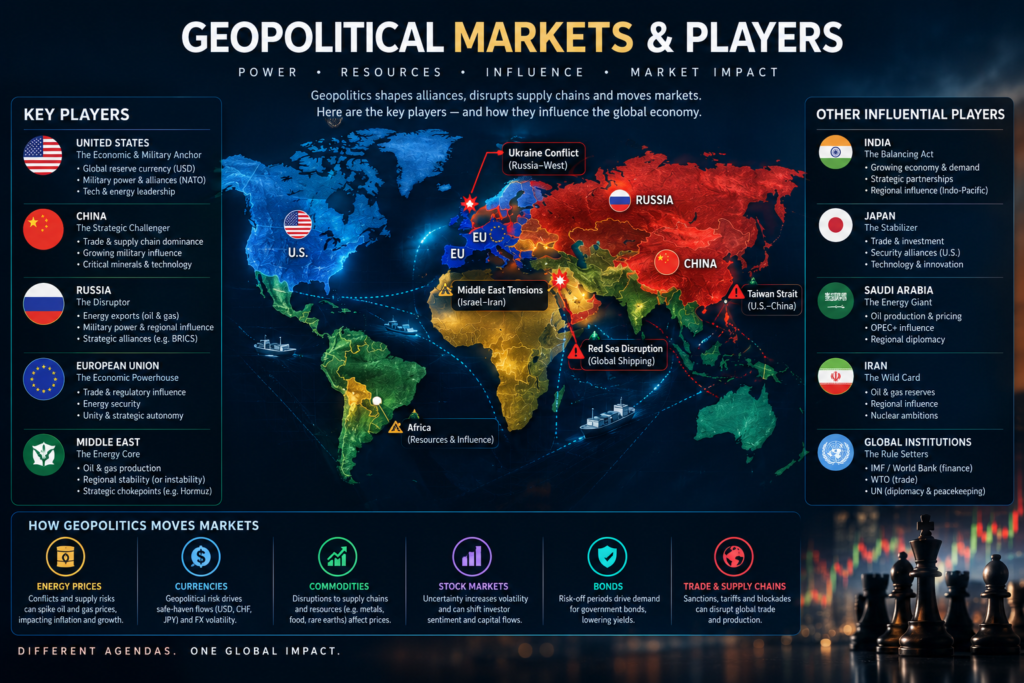
In-Depth Geopolitical Market & News Analysis Monday, October 5, 2026
Global markets open the week under the dual influence of persistent Middle East volatility and selective risk appetite, driven by recovering energy flows, soft U.S. labor data, and lingering questions over the durability of any U.S.-Iran de-escalation. Equity indices in the U.S. closed Friday higher (S&P 500 near 7,723, Nasdaq outperforming), while Asia-Pacific trading is mixed, with Japan’s Nikkei notably strong and mainland China/South Korea markets closed for holidays. Bond yields remain elevated (U.S. 10-year around 5.25–5.28%), oil has eased modestly from recent spikes but stays structurally high, and gold holds elevated levels amid shifting Fed expectations.
1. Middle East Flashpoint: U.S.-Iran Tensions and Energy Markets
The dominant geopolitical driver remains the U.S.-Iran confrontation and related regional spillover. The United States continues to expand its military footprint, deploying a third aircraft carrier strike group and additional personnel amid tensions with Iran. Iranian parliamentary statements have reiterated conditions for reopening the Strait of Hormuz, keeping shipping risk elevated even as physical crude exports from the Gulf have recovered toward or above pre-conflict levels on several recent days.
Yemen’s conflict has intensified: Houthi forces have seized additional territory and claimed strikes on Saudi energy infrastructure, while Saudi-backed forces and the Yemeni government have launched broader offensives. The U.S. has also relocated B-1 bombers from a UK base following a security investigation related to a planned attack.
Market impact: Brent crude trades near $101–102 per barrel and WTI around $90, down modestly on the day as higher Middle East loadings and G7 plans to release up to 100 million barrels of crude and diesel (prioritizing diesel) ease immediate supply fears. Volatility remains extreme—earlier weeks saw sharp intraday swings on ceasefire rumors and subsequent escalations. Analyst scenarios range from a return toward $80 if flows normalize fully to $120+ if attacks on shipping or infrastructure intensify. Energy prices continue to feed into broader inflation concerns, supporting higher-for-longer rate expectations in some segments while soft recent U.S. payrolls data has tempered near-term Fed hike odds.
Elevated oil also pressures consumer confidence and real incomes in energy-importing economies, contributing to caution in rate-sensitive equity sectors.
2. Ukraine-Russia War: Attrition Continues Amid Western Support Signals
The conflict shows no resolution. Russia has continued drone and missile strikes targeting Ukrainian infrastructure and urban areas (including Kyiv-region impacts), while Ukraine maintains defensive and counter-strike capabilities. German Chancellor Friedrich Merz made an unannounced visit to Kyiv with pledges of further support, underscoring European commitment even as U.S. attention remains heavily focused on the Middle East.
Broader analysis links the Ukraine theater to the “CRINK” axis dynamics (China-Russia-Iran-North Korea), with technology and material transfers noted by various observers. India’s External Affairs Minister has publicly acknowledged stepped-up diplomatic engagement with both Moscow and Kyiv.
Market relevance: Persistent European energy and fiscal pressures from the war, combined with Middle East oil risk, keep inflation sticky and limit aggressive monetary easing. Defense and related industrial names retain structural support; broader European equities remain sensitive to any escalation or diplomatic breakthroughs.
3. Great Power Dynamics: U.S.-China and Indo-Pacific
A late-September Trump-Xi summit produced modest concrete outcomes: limited tariff reductions on non-sensitive goods, a short extension of the existing trade truce, and a new dialogue channel on AI safety. Taiwan remains the core unresolved tension—Beijing restated its red lines, while U.S. arms deliveries have faced delays amid resource strains from the Iran conflict. Some analysts argue China has been a relative strategic beneficiary of the U.S.-Iran war through reduced U.S. bandwidth and favorable optics as a “responsible” actor in certain global forums.
In the South China Sea/near Taiwan, the Philippines has challenged Chinese research vessels, highlighting ongoing maritime friction. U.S. assessments reportedly view a near-term (pre-2028) Chinese invasion of Taiwan as less likely due to readiness and political timing factors.
Market relevance: Geoeconomic risk—particularly supply-chain exposure of U.S. firms to Chinese customers and critical minerals—remains a priced factor in equities. Technology and semiconductor names continue to benefit from AI demand but face valuation sensitivity and export-control overhangs. A stable (if fragile) U.S.-China commercial channel supports risk assets relative to a sharper decoupling scenario.
4. Other Notable Developments
- Brazil: First-round presidential voting on October 4 produced no outright winner. Incumbent Luiz Inácio Lula da Silva and Senator Flávio Bolsonaro (son of the former president and viewed as closer to the Trump orbit) advance to an October 25 runoff. Markets will watch for continuity in China trade ties versus potential closer U.S. alignment.
- South Asia: India-Pakistan tensions flared after a border incident in Punjab (October 2). Swiss President Guy Parmelin begins a three-day official visit to India. India finished fourth at the Aichi-Nagoya Asian Games with 85 medals.
- Africa: Ethiopian forces captured Mekelle (Tigray capital) after TPLF withdrawal; Sudanese conflict continues with reported attacks on humanitarian assets; Egypt hosts regional leaders amid East African tensions.
- Europe: Kosovo faces a constitutional deadline around its acting presidency and Specialist Chambers amendments. Latvia’s pro-European forces performed strongly in parliamentary elections.
5. Market Cross-Currents and Outlook
Equities: U.S. indices recovered Friday on weaker-than-expected jobs data (reducing near-term hike probability) and continued AI/earnings momentum in select names. Asia is mixed; Japan benefits from weaker yen dynamics and tech strength. Rate-sensitive and consumer discretionary sectors remain vulnerable to high yields and energy costs.
Fixed Income & Currency: Long-end Treasury yields have reached multi-decade highs in recent sessions, reflecting inflation persistence and fiscal concerns (including European sovereign spreads, notably France). The dollar remains firm near multi-month highs. Soft labor data provides some counterbalance.
Commodities & Safe Havens: Oil’s supply recovery narrative competes with geopolitical risk premium. Gold trades around the mid-$4,100s, supported by lower rate-hike odds but previously pressured by yields and a strong dollar. Silver and platinum have shown relative firmness in recent sessions.
Key Risks to Watch This Week:
- Any disruption to Hormuz shipping or further Houthi/Saudi escalations.
- Clarity (or lack thereof) on U.S.-Iran diplomatic tracks.
- Brazilian runoff positioning and any policy signals.
- U.S. economic data and Fed speak against the backdrop of elevated energy prices.
- Secondary effects on European growth and emerging-market funding costs.
Bottom line for investors and policymakers: The world is operating in a multipolar risk environment where Middle East energy shocks, great-power competition, and regional wars interact. Markets are pricing partial normalization of oil flows while retaining a meaningful geopolitical premium. Equity resilience has been notable, but high real yields and sticky inflation from energy leave limited room for error. Positioning that emphasizes energy security, diversified supply chains, selective technology exposure, and quality duration appears better aligned with the current regime than pure risk-on or pure defensive stances.
This analysis reflects conditions as of early October 5th, 2026. The analysis is for informational and educational purposes. Market conditions change rapidly—always conduct your own due diligence or consult a financial advisor.