
Executive Summary
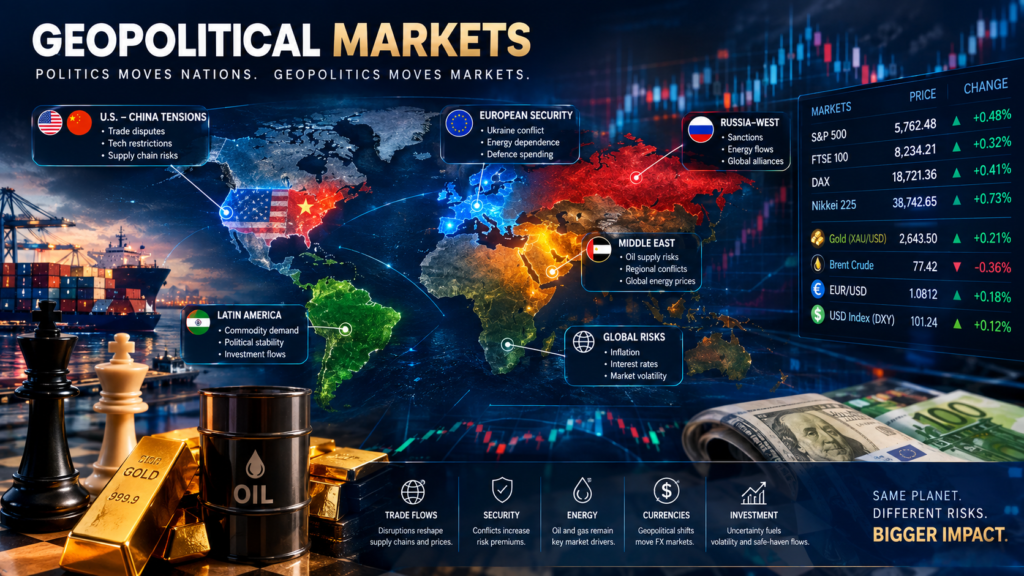
As of late September 2026, global markets are navigating a multipolar risk environment defined by protracted conflicts, intensifying great-power competition, energy realignments, and shifting alliance structures. The primary drivers remain the Russia-Ukraine war, Middle East instability (Israel-Iran axis and Red Sea security), U.S.-China strategic rivalry (Taiwan, technology, and trade), and the evolving roles of India, the Gulf states, and Europe.
Equity markets have shown resilience through selective decoupling and fiscal support, but elevated geopolitical risk premiums persist in energy, defense, shipping, and critical minerals. Safe-haven demand (gold, USD, Swiss franc) remains firm, while commodity volatility and supply-chain reconfiguration continue to shape inflation trajectories and central-bank policy paths.
1. Russia-Ukraine Conflict: Attrition, Energy, and European Security
The war has entered a grinding phase of attrition. Russia continues to leverage energy exports (pipeline gas to select European and Asian buyers plus seaborne oil via the shadow fleet) while facing sustained Western sanctions and Ukrainian long-range strikes. Ukraine’s defense remains heavily dependent on Western military and financial support, with periodic debates in the U.S. and Europe over funding durability.
Market implications:
- European natural gas prices remain sensitive to any disruption in remaining Russian volumes or extreme winter demand, though LNG diversification and storage have reduced the acute crisis risk of 2022–23.
- Defense stocks across NATO countries and key suppliers continue to benefit from elevated spending commitments.
- Agricultural commodities (wheat, corn, sunflower oil) retain a risk premium tied to Black Sea export corridors.
- Russian assets remain largely isolated from Western capital markets; any meaningful de-escalation or frozen-conflict scenario would likely trigger sharp re-rating discussions.
2. Middle East: Iran, Israel, and Maritime Security
Tensions involving Israel, Iran, and non-state actors (including residual Red Sea and Gulf of Aden threats) continue to influence oil risk premiums and shipping costs. Iran’s nuclear program and regional proxy network remain flashpoints. Gulf states have pursued a dual strategy of security cooperation with the U.S. alongside deepening economic ties with China and India.
Market implications:
- Brent crude retains a geopolitical risk premium. Any significant disruption to Strait of Hormuz transit or major production facilities would rapidly elevate prices and inflation expectations.
- Shipping and marine insurance costs on key routes stay elevated relative to pre-2023 levels.
- Gulf sovereign wealth funds and energy majors remain active capital allocators into global infrastructure, technology, and energy transition assets.
- Defense and cybersecurity sectors see sustained demand from regional governments.
3. U.S.-China Strategic Competition
Technology export controls, investment screening, semiconductor supply chains, and Taiwan contingency planning dominate the relationship. China continues industrial policy support for advanced manufacturing, EVs, batteries, and critical minerals processing, while facing demographic headwinds and property-sector adjustment. The United States and allies pursue “friend-shoring” and industrial policy (chips, clean energy, critical minerals).
Market implications:
- Semiconductor and advanced manufacturing equities remain bifurcated between U.S./allied and Chinese supply chains.
- Critical minerals (lithium, rare earths, copper, nickel) prices and investment flows reflect both energy-transition demand and security-of-supply concerns.
- Multinational corporations continue supply-chain diversification toward Southeast Asia, India, Mexico, and Eastern Europe, supporting related infrastructure and logistics plays.
- Currency and capital-flow dynamics remain sensitive to any escalation in trade or technology restrictions.
4. Emerging Powers and Multipolar Realignment
India’s economic growth, manufacturing push, and strategic autonomy position it as a key beneficiary of supply-chain shifts. The Gulf states (Saudi Arabia, UAE, Qatar) are accelerating diversification beyond oil while maintaining energy leverage. BRICS+ expansion and alternative payment/settlement discussions reflect efforts to reduce single-currency dependence, though the dollar’s dominance in trade and reserves remains intact for now.
Europe faces the dual challenge of energy security, defense spending increases, and competitiveness relative to the U.S. and Asia. Fiscal constraints and political fragmentation in several countries add policy uncertainty.
5. Cross-Cutting Market Themes
- Energy transition vs. energy security: Governments and companies are balancing decarbonization timelines with near-term reliability and affordability. This supports investment in both traditional hydrocarbons (especially LNG and oil services in secure jurisdictions) and renewables, nuclear, and grid infrastructure.
- Defense and dual-use technology: Elevated global military spending is a multi-year structural theme spanning aerospace, munitions, cybersecurity, space, and AI-enabled systems.
- Commodities and inflation: Geopolitical supply risks keep a floor under certain commodity prices and complicate central-bank efforts to achieve durable disinflation.
- Currency and capital flows: The U.S. dollar retains safe-haven status during acute risk-off episodes. Gold has benefited from central-bank buying (particularly from non-Western institutions) and geopolitical uncertainty.
- Equity market structure: Markets have increasingly priced “selective decoupling” rather than full globalization reversal. Sectors with pricing power, strong balance sheets, and exposure to defense, energy security, and friend-shoring have outperformed pure cyclical plays sensitive to trade disruption.
Risks to Monitor
Near-term catalysts that could reprice assets include:
- Major escalation or de-escalation in Ukraine or the Middle East.
- Significant Taiwan Strait incident or further tightening of technology controls.
- Disruptions to key energy chokepoints or production.
- Shifts in U.S. or European political support for ongoing conflicts and industrial policy.
- Coordinated moves toward alternative reserve assets or payment systems that gain meaningful traction.
Investment and Policy Takeaways
- Maintain diversified exposure with explicit geopolitical risk overlays (energy security, defense, critical minerals, logistics).
- Monitor shipping rates, oil risk premiums, and defense budget trajectories as leading indicators.
- Corporate strategies emphasizing supply-chain resilience and dual-use technology capabilities are likely to command valuation premiums.
- Policymakers face the ongoing tension between short-term market stability and longer-term strategic decoupling goals.
This analysis reflects conditions as of early September 22nd, 2026. The analysis is for informational and educational purposes. Market conditions change rapidly—always conduct your own due diligence or consult a financial advisor.