
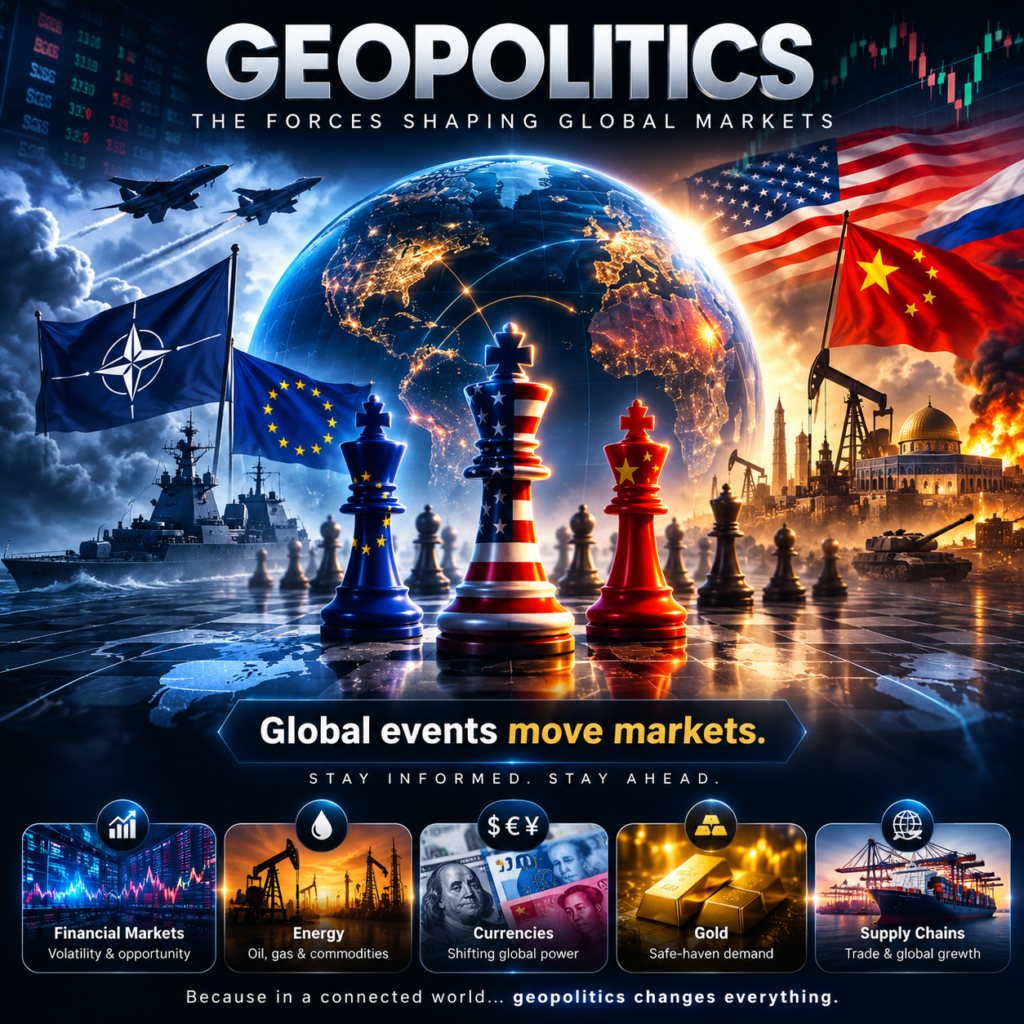
Geopolitical Market Analysis: Navigating Volatility in a Fragmented World – Mid-2026
Executive Summary
As of late July 2026, global markets face elevated geopolitical risks dominated by the ongoing Iran conflict, persistent US-China strategic competition, and lingering effects from the Russia-Ukraine war. These tensions have triggered energy supply disruptions, particularly through the Strait of Hormuz, driving oil price volatility and contributing to a projected slowdown in global GDP growth to around 2.5–3.0% for 2026.
While markets have shown resilience—recovering from early-year dips tied to Middle East escalations—investors must contend with higher risk premiums, sector rotations toward defense and commodities, and currency shifts favoring selective non-USD assets. Opportunities exist in energy security plays, AI-driven productivity, and diversified supply chains, but downside risks from escalation or policy missteps remain significant.
1. Key Geopolitical Flashpoints
Middle East / Iran Conflict (Primary Driver in 2026)
The 2026 Iran-related conflict, involving US-Israel operations and disruptions to the Strait of Hormuz, represents the most acute energy security crisis since the 1970s. Disruptions displaced significant crude and LNG volumes, with partial offsets from US exports, alternative routes, and emergency releases. Oil prices surged sharply (Brent from ~$72 to peaks near $120/bbl), with pronounced effects on diesel and jet fuel due to refined product shortages.
As of mid-2026, negotiations and partial reopenings have eased some pressures, but uncertainty persists. This has fueled inflation concerns, tighter monetary policy expectations in some regions, and calls for greater energy diversification.
US-China Relations: Managed Competition
Bilateral ties feature a fragile “strategic stability” framework post-summits, with tariff truces, new dialogue mechanisms, and selective rollbacks. However, investigations, tech export controls, and critical minerals restrictions continue. Tariffs remain elevated (though moderated from peaks), and decoupling pressures endure in strategic sectors.
China focuses on domestic resilience and alternative trade partnerships, while the US emphasizes “reciprocal” trade and supply chain security. This dynamic raises risk premiums but has not triggered full-scale economic rupture.
Russia-Ukraine and Broader Fragmentation
Ongoing effects include reshaped energy trade (Europe’s reduced Russian dependence, accelerated renewables), sanctions evasion patterns, and sustained defense spending increases across NATO and allies. Multipolarity and geoeconomic confrontation rank as top global risks through the coming years.
Other factors: Regional instabilities, Arctic/resource competition, and weakening multilateral cooperation on climate and trade.
2. Macroeconomic and Market Impacts
Global Growth and Inflation
Projections show 2026 global growth slowing, pressured by energy shocks, with uneven regional outcomes (stronger in some commodity exporters, weaker in energy importers). Inflation has re-accelerated in affected regions due to energy and shipping costs, complicating central bank paths. AI adoption and fiscal supports provide partial offsets.
Commodities
- Oil & Energy: High volatility with risk premiums embedded. Beneficiaries include US producers and alternatives (LNG, renewables acceleration). Refined products faced acute squeezes.
- Gold: Strong performer as a hedge amid uncertainty, currency debasement fears, and diversification away from USD assets, though subject to short-term crowded-trade selloffs during acute events.
- Other: Gains in select metals tied to defense/tech; agricultural and shipping disruptions in some cases.
Equities and Sectors
Broad indices showed initial dips on Iran news but rebounded on resilient earnings, consumer spending, and AI momentum. Defense stocks benefited from spending surges; energy mixed due to volatility. Rotations favored value and small-caps in some periods; international/EM outperformance in diversification plays. Tech/AI remains a structural tailwind despite geopolitical noise.
Fixed Income and Currencies
Bonds faced pressure from inflation risks and policy divergence. The USD has seen general weakness amid easing cycles and narrower rate differentials. EUR, GBP, and CNY show selective strength. Higher volatility in EM currencies tied to commodity and risk sentiment.
3. Sector and Thematic Opportunities/Risks
Winners:
- Defense and aerospace (elevated global spending).
- US energy exporters and diversified producers.
- Gold and precious metals as hedges.
- Companies building resilient, friend-shored supply chains.
- AI/tech enabling productivity amid labor/energy constraints.
Losers/Risks:
- Energy-intensive industries and importers without hedges.
- Global trade-dependent firms facing tariff/fragmentation costs.
- Overleveraged sovereigns in high-debt environments.
Investment Themes:
- Energy security and transition acceleration.
- Supply chain redundancy.
- Scenario planning for multipolar outcomes.
4. Outlook and Recommendations for Investors/Businesses
Base Case (Most Likely): Contained Iran conflict with gradual energy normalization; managed US-China tensions; modest global slowdown with AI/fiscal offsets. Markets grind higher with volatility, favoring quality, diversified, and thematic exposures.
Downside Risks: Escalation in Hormuz or broader conflicts; tariff spirals; stagflationary mix.
Upside: Quick de-escalation, stronger AI productivity, or commodity supply rebounds.
Practical Advice:
- Diversify geographically and across asset classes (gold, defense, commodities, international equities).
- Hedge energy and currency exposures where material.
- Stress-test supply chains for geopolitical chokepoints.
- Monitor policy signals closely.
- Maintain liquidity and flexibility—geopolitical shocks often create short-term volatility but longer-term recoveries when fundamentals hold.
Geopolitics is no longer “background noise”—it is a core driver of returns, risk premiums, and corporate strategy in 2026 and beyond. Businesses and investors who embed scenario planning, resilience, and selective opportunism will be best positioned in this era of structural competition and fragmentation.
This analysis is for informational purposes only and draws on publicly available information as of late July 2026. Markets can shift rapidly; consult professional advisors for tailored guidance.